Guide
APR vs Interest Rate: What's the Difference?
Learn what the interest rate and APR each measure, how fees create a gap between them, and when total cost is the better comparison.
Seeing two percentages on a loan offer is confusing until you separate their jobs. The interest rate helps determine the scheduled payment. The APR is meant to express the yearly borrowing cost after qualifying fees are included. When an offer has fees, the loan with the lower interest rate can still cost more. The worked comparison below shows how that happens.
Two numbers, two jobs
The interest rate (the "nominal" or "note" rate) is the rate applied to your outstanding balance to accrue interest. Divide it by 12 and you have the monthly rate that drives the payment formula and the amortization schedule — the mechanics covered in how loan interest works. It says nothing about fees.
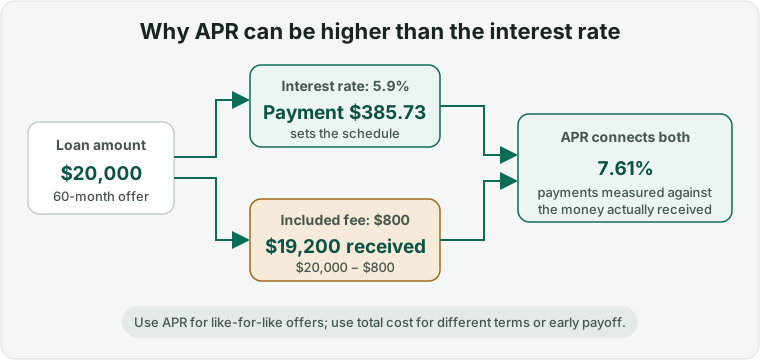
The APR (annual percentage rate) is a disclosure figure, not a separate rate charged to the balance. It converts interest and the fees included by the applicable disclosure rules into a yearly rate. If an $800 origination fee is deducted from a $20,000 loan, you receive $19,200 but make payments calculated on $20,000. The APR is the rate that matches those payments to the smaller amount received. The CFPB's explainer on mortgage rates versus APR covers this distinction for US mortgages. Which charges belong in APR depends on the product and jurisdiction, so read the itemized disclosure as well as the percentage.
What APR includes — and what it doesn't
- Included: origination and processing fees, mandatory administration charges, discount points on a mortgage, and any insurance the lender requires as a condition of the loan.
- Not included: optional add-ons (payment protection insurance you chose), penalties that depend on your behavior (late fees, prepayment charges), and typically some third-party costs such as appraisal or notary fees, though the exact list varies.
The US (Regulation Z, the Truth in Lending rule), the EU (APRC under the Consumer Credit Directive), the UK, and India each draw the included-fees line slightly differently, and the EU convention compounds the rate where the US convention doesn't. The numbers below use the US-style monthly convention. The principle is universal (APR = payments measured against what you received), but only compare APRs computed under the same country's rules.
A computed example: when the lower rate is the worse deal
Imagine Meera needs $20,000 for a used car and a repair buffer. She has two 60-month offers. Loan B looks friendlier in the advertisement, but its fee is withheld before the money reaches her:
Loan A: payment on $20,000 at 6.4% for 60 months is $390.39. Total repaid: $23,423.21. No fees, so APR = 6.4%.
Loan B: payment on $20,000 at 5.9% is $385.73, about $4.66 less per month. But the $800 fee means you only received $19,200. Total cost: $23,143.60 in payments + $800 = $23,943.60, a full $520.39 more than Loan A.
Loan B's APR is the rate at which 60 payments of $385.73 are worth exactly $19,200 today. Solving for that rate gives 7.61%. So the true comparison is 6.4% vs 7.61%, and Loan A wins despite the higher sticker rate.
| Loan A | Loan B | |
|---|---|---|
| Interest rate | 6.4% | 5.9% (lower) |
| Fees | $0 | $800 |
| Monthly payment | $390.39 | $385.73 (lower) |
| Total cost (payments + fees) | $23,423.21 (lower) | $23,943.60 |
| APR | 6.4% (lower) | 7.61% |
Loan B wins on the two numbers an advertisement shows (rate and payment) and loses on the two that matter. This is precisely the situation APR exists to expose. Its $4.66 monthly saving is coffee-sized; the $800 fee is not. Recouping that fee would take about 172 months, yet the loan only runs 60, so B can never catch up. Whenever a fee buys a rate discount, that break-even division (fee ÷ monthly saving) is the fastest sanity check available, and it's exactly the calculation behind whether mortgage discount points are worth paying. The Loan Comparison Calculator runs this computation for any pair of offers, and the broader checklist lives in how to compare loan offers.
Where APR misleads
APR is calibrated to one scenario: you keep the loan for its full term. Break that assumption and the ranking can flip back.
Short holding periods. An upfront fee is paid once, but APR spreads it across the whole term. Repay early and the fee is concentrated into fewer years, so the true annual cost rises above the disclosed APR. Take Loan B again: if you repay it after 24 months (remaining balance $12,698.13), the effective annual cost of those two years — 24 payments plus the payoff, measured against the $19,200 received — works out to 8.52%, well above the 7.61% full-term APR. This is why mortgage discount points are usually poor value if you might sell or refinance within a few years: the fee is sunk on day one, the rate saving needs years to repay it.
Comparing across terms, and the mortgage case
APR is an annualized rate, not a total. A 36-month loan and a 72-month loan at the same APR are radically different commitments — the longer one accrues that rate over twice as many years and costs far more in total interest. APR ranks loans of the same amount and term; across different terms, compare total cost and monthly payment side by side instead.
Mortgages deserve special care. Home loans carry the largest fee stacks (origination, points, and various closing costs), so the rate-to-APR gap is usually widest there, and the short-holding-period problem bites hardest because many 30-year mortgages end early through a sale or refinance. For adjustable-rate mortgages, the disclosed APR also embeds an assumption about where the rate goes after the fixed period, which makes it closer to a forecast than a fact. Use the Mortgage Calculator to see the payment mechanics, but evaluate fees against the years you realistically expect to keep the loan.
Promotional rates with mandatory fees have a positive APR by definition. And a "0% for 12 months" card or loan that jumps afterward needs to be evaluated over your realistic payoff horizon, not the promo window.
The savings-side mirror: APY and AER
Savings products have the same two-number structure, mirrored. The nominal rate understates what a savings account pays, because it ignores intra-year compounding; APY (annual percentage yield, called AER in the UK) states the true yearly growth with compounding included. A 5% nominal rate compounded monthly is a 5.12% APY.
The labels are similar but they should not be used interchangeably. APR helps compare borrowing costs under the relevant disclosure rules; APY helps compare deposit growth after compounding. The compounding mechanics behind APY are worked through in how compound interest works.
How to use each number
- Budgeting? Use the interest rate: together with the term, it determines your monthly payment. The Loan Calculator gives you payment and schedule from it.
- Comparing offers with the same amount and term? Use APR. It's the single number designed for exactly this.
- Comparing different terms, or planning early payoff? Use total cost over your realistic horizon. APR's full-term assumption breaks here.
- Reading any offer? If APR is well above the quoted rate, that gap is fees. Ask for the itemized list before signing.
- Refinancing? The new loan's fees are a fresh upfront cost against a rate saving that accrues slowly. The same break-even division as above, measured against how long you'll keep the new loan, decides it.
Use the regulated cost disclosure supplied with the offer, but do not stop at one percentage. Confirm which fees it includes and compare the total amount paid over the period you realistically expect to keep the loan. APR is most useful when the loan amount, term and expected holding period are alike.
Beginner questions about APR
Is the loan with the lowest APR always the cheapest?
It is usually the best starting point only when the loan amount, term and expected payoff date are comparable. A longer loan can show a similar APR while costing much more in total interest, and a fee-heavy loan can be poor value if you repay early. Compare the payment, upfront cash, total cost and your realistic holding period together.
Can APR equal the interest rate?
Yes. If the calculation includes no qualifying fees and uses the same rate convention, APR can match the stated interest rate. A visible gap between the two usually signals included fees or another financed cost, but the disclosure should show the actual items rather than leaving you to infer them.
Does APR include every fee I will pay?
No. The included charges depend on the product and the disclosure rules in the relevant country. Optional products, behavior-based charges and some third-party costs may sit outside APR. Read the itemized fee list and ask for the total amount payable; one percentage cannot describe every cash outflow.